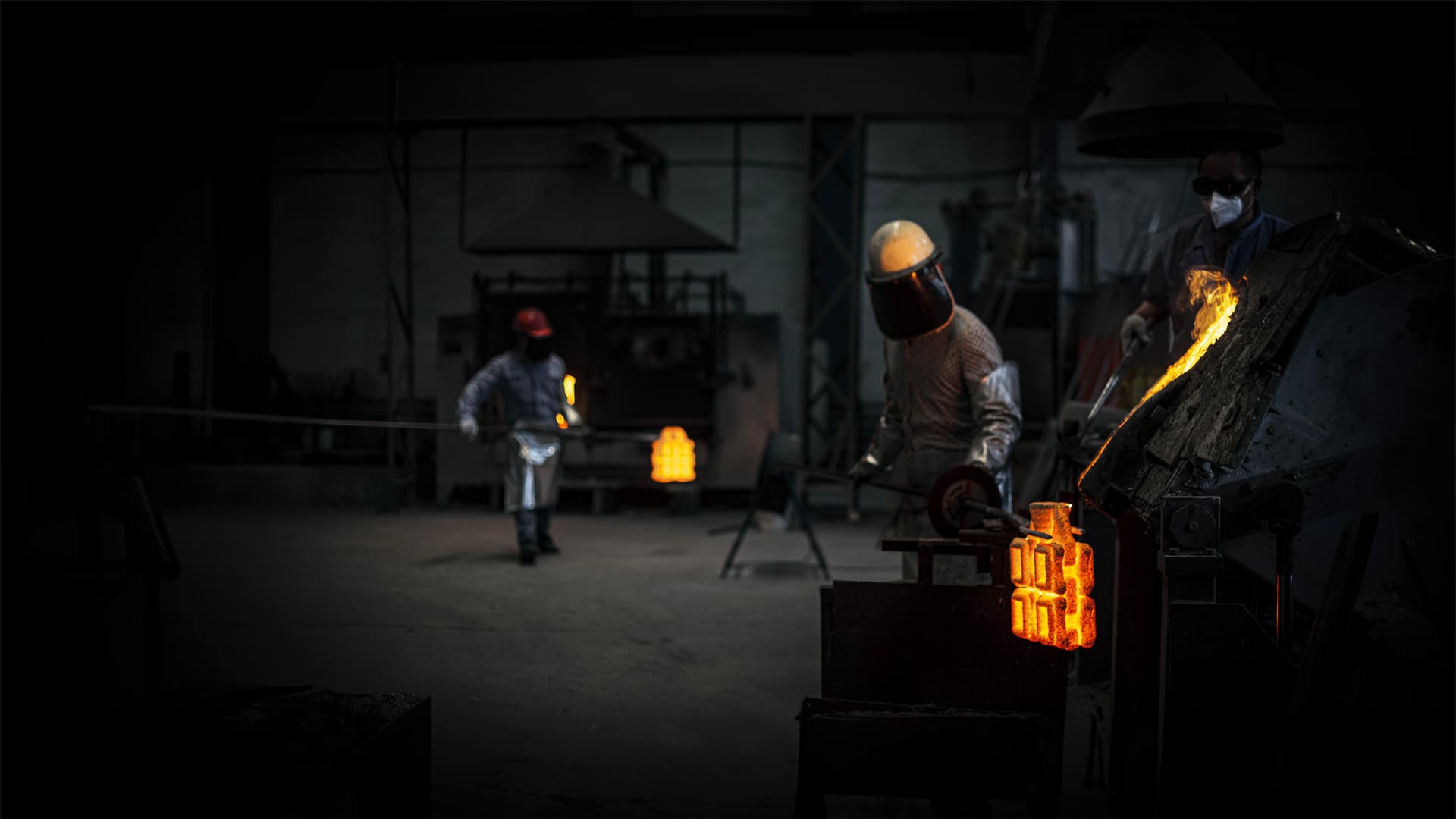
Investment Casting Process
Precision lost-wax casting with silica-sol ceramic shells, producing complex geometries at tolerances down to ±0.1mm in stainless steel, carbon steel, and alloy grades.
What is Investment Casting?
Investment casting, also called lost-wax casting or precision casting, shapes metal by pouring it into a ceramic mold built around a wax pattern. The mold reproduces the pattern almost exactly, which is why the process holds tight dimensional accuracy and a smooth surface straight out of the shell. The technique itself is ancient (bronze-age foundries used it to cast jewelry and statuary), but modern foundries pair it with computer-controlled shell building, spectrometer-verified alloys, and CMM inspection to hold tolerances a century-old bronze caster never had to worry about.
At Quintex, we run silica sol investment casting, which binds the ceramic shell with colloidal silica instead of the sodium silicate ("water glass") used in older processes. The silica sol shell holds finer detail and a smoother surface, which is why we use it for automotive, industrial, and energy components that need to come off the tree close to their final dimensions.
Quintex was founded in 1998 and is headquartered in Taiwan. The group now employs more than 600 people across its foundries in China, running 100+ CNC platforms with combined output above 3,500 tons a year. We supply over 300 clients in Europe, the United States, and Japan, casting stainless steel, carbon steel, and low-alloy steel parts for automotive, oil and gas, food machinery, and general industrial equipment.
The 6-Step Investment Casting Process
Three stages below carry a real production photo, cropped for a consistent frame and credited to its source. The rest use a plain icon since we don't yet have a licensed photo for that stage.
Pattern Creation
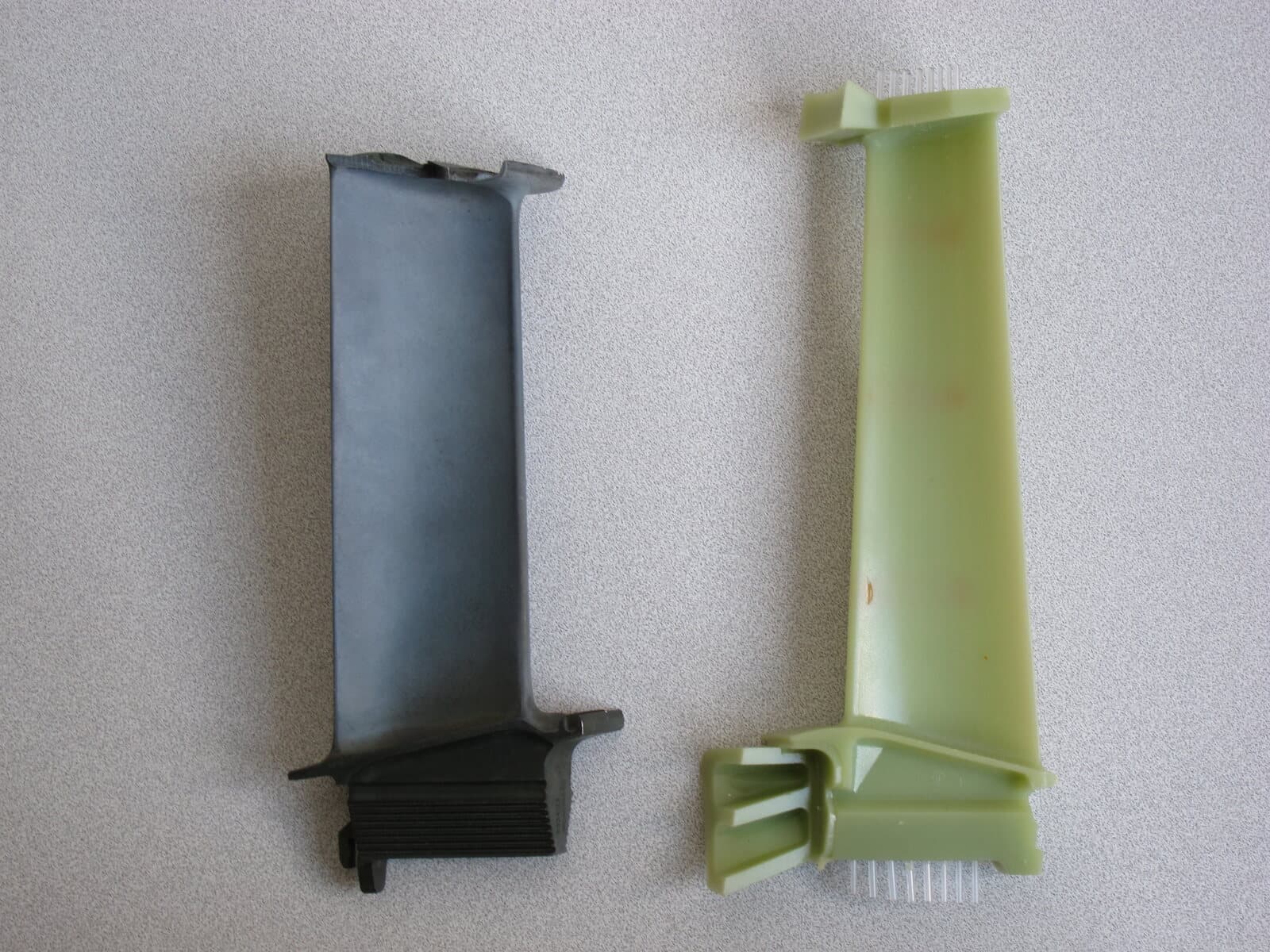
Precision injection molds shape a wax pattern that replicates the final metal part's geometry, at tolerances as tight as ±0.1mm.
A nickel-alloy turbine blade beside the wax pattern used to cast parts of the same shape. The wax burns away later in the process; the metal keeps its form. Olivier Cleynen, CC BY-SA 3.0, via Wikimedia Commons (cropped)
Assembly (Tree Building)
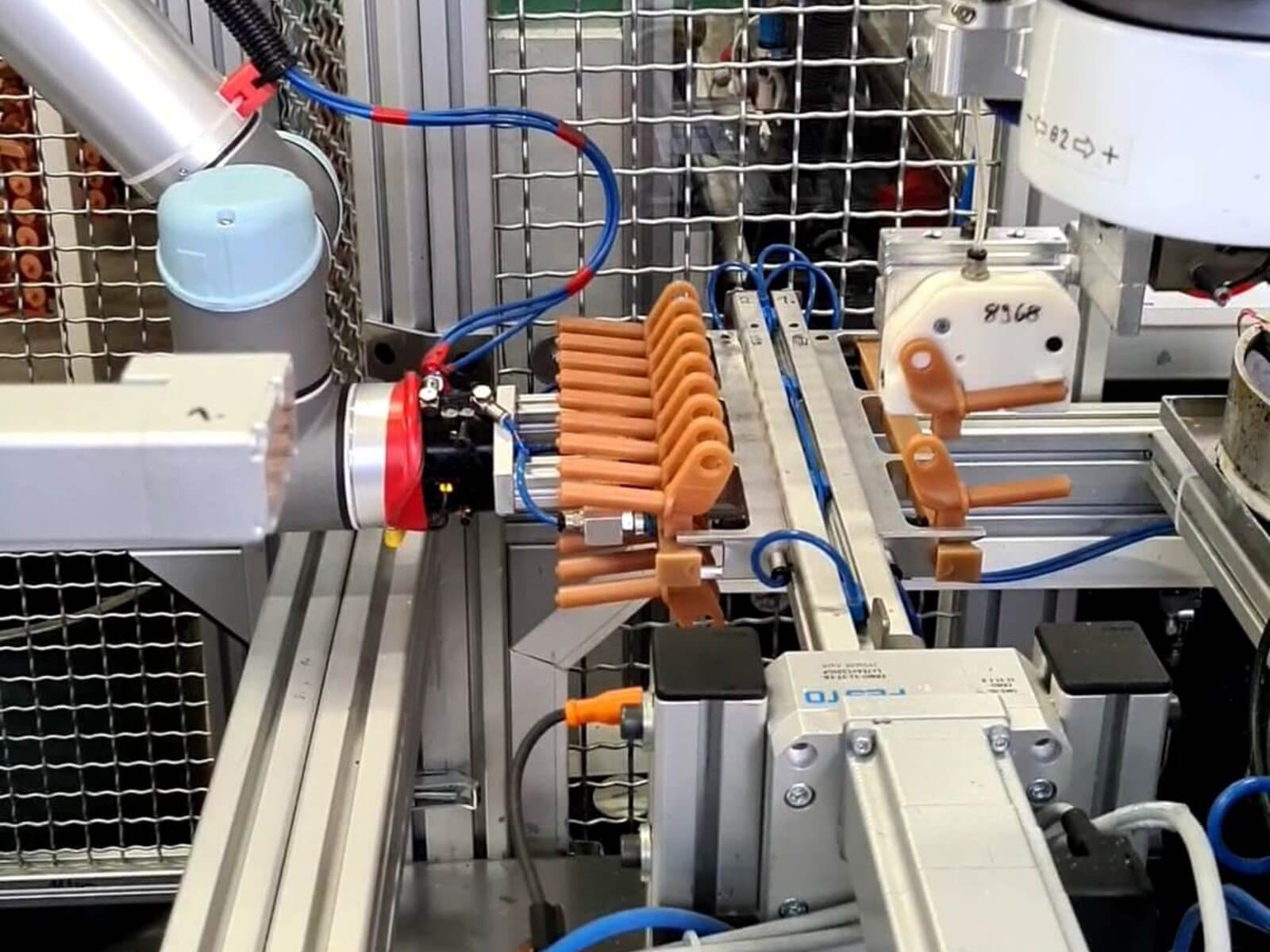
Individual wax patterns attach to a central wax sprue, forming a tree that lets us cast several parts in one pour.
A robotic arm sets wax patterns onto a central sprue, building the tree that will carry several parts through one ceramic shell and one pour. FEINGUSS BLANK GmbH, CC BY-SA 4.0, via Wikimedia Commons (cropped)
Shell Building
The tree is dipped repeatedly in silica-sol ceramic slurry and coated with fine sand each time, building a ceramic shell 6-10mm thick.
Dewaxing
An autoclave heats the ceramic shell to melt out and drain the wax, leaving a hollow mold shaped exactly like the finished part's cavity.
Metal Pouring
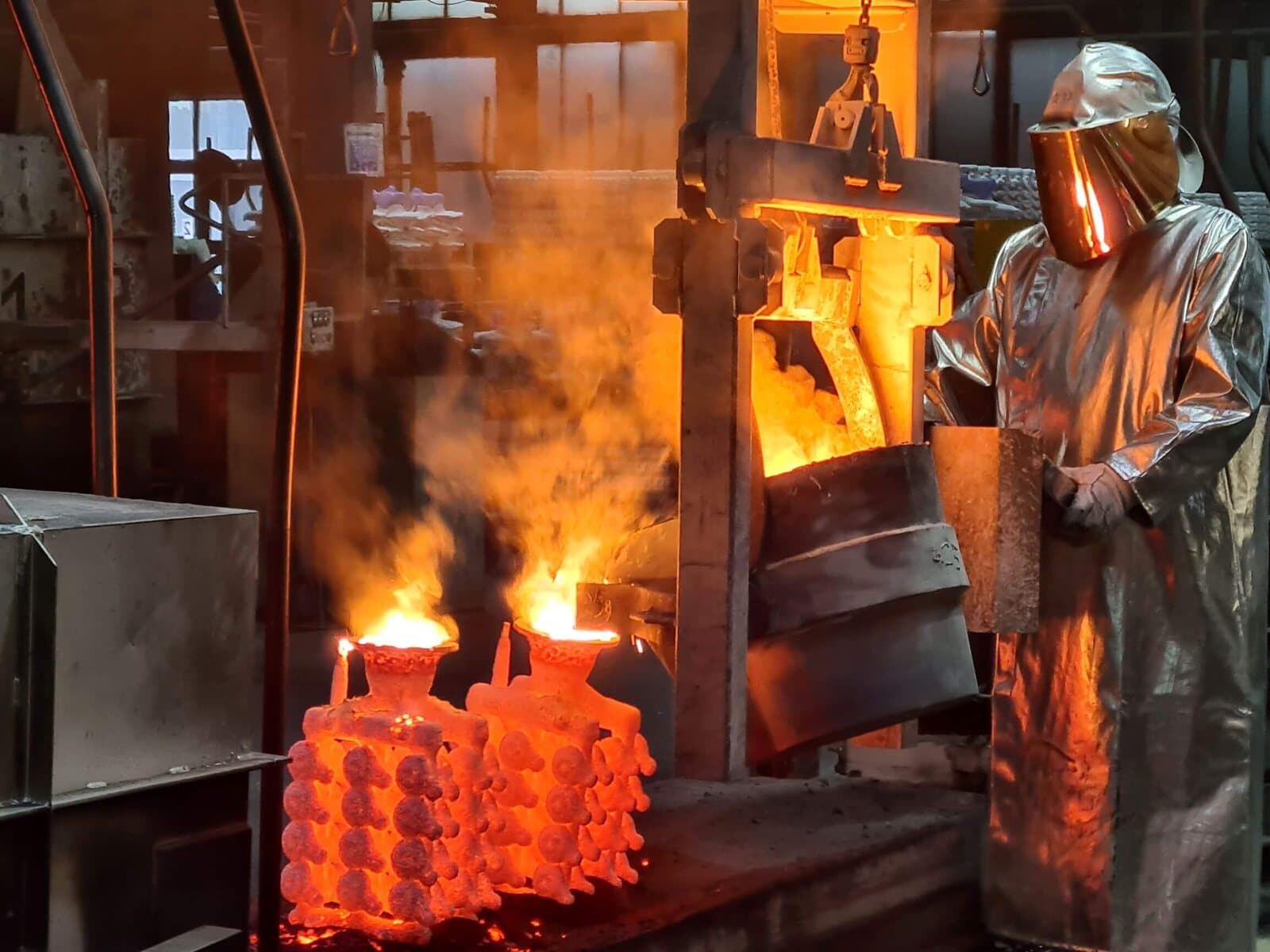
We pour molten metal, stainless steel, carbon steel, or a specialty alloy, into the preheated ceramic mold under controlled conditions.
Molten steel goes into a preheated ceramic shell. The wax is already gone; what's left is a cavity in the exact shape of the tree it replaced. FEINGUSS BLANK GmbH, CC BY-SA 4.0, via Wikimedia Commons (cropped)
Shell Removal & Finishing
Once the casting cools, we break away the ceramic shell, cut the parts from the tree, then grind, machine, and polish each one to final spec.
Our Investment Casting Capabilities
Silica Sol Precision Casting
Our primary process, used for automotive and industrial components that need tight tolerances and a fine surface finish (Ra 3.2-6.3 μm).
Material Expertise
304/316 stainless steel, CF8/CF8M, carbon steel, low-alloy steel, and specialty alloys, each verified by spectrometer analysis before it ships.
In-House CNC Machining
100+ CNC platforms across our foundries handle secondary machining, holding ±0.02mm on critical features.
Quality Assurance
ISO 9001, IATF 16949, and Volkswagen Germany certified, with CMM inspection, X-ray testing, pressure leak testing, and full dimensional reporting on every order. The group also holds China's 'Little Giant' and 'Specialized and Sophisticated' designations for high-growth specialist manufacturers.
Technical Specifications
Frequently Asked Questions
What is investment casting?
Investment casting, also called lost-wax casting, shapes metal by pouring it into a ceramic mold built around a wax pattern that gets melted out before pouring. Because the mold reproduces the pattern almost exactly, the process suits parts that need tight tolerances, complex geometry, or a smooth as-cast surface.
What materials can be investment cast?
Quintex investment-casts stainless steels (304, 316, CF8, CF8M), carbon steels, low-alloy steels, and specialty alloys for automotive, industrial, and energy customers.
What tolerances can investment casting achieve?
Our silica-sol process holds ±0.1mm (±0.004in) as-cast. Secondary CNC machining brings critical features down to ±0.02mm.
Does Quintex offer investment casting in Vietnam?
Yes. Acewell Vietnam, our new facility in Hung Yen Province, is scheduled to start production in 2027 as a Taiwan-managed China+1 option.
Ready to Discuss Your Investment Casting Project?
Our engineering team can review your drawings, recommend the optimal process, and provide a detailed quotation.
Contact Our Team